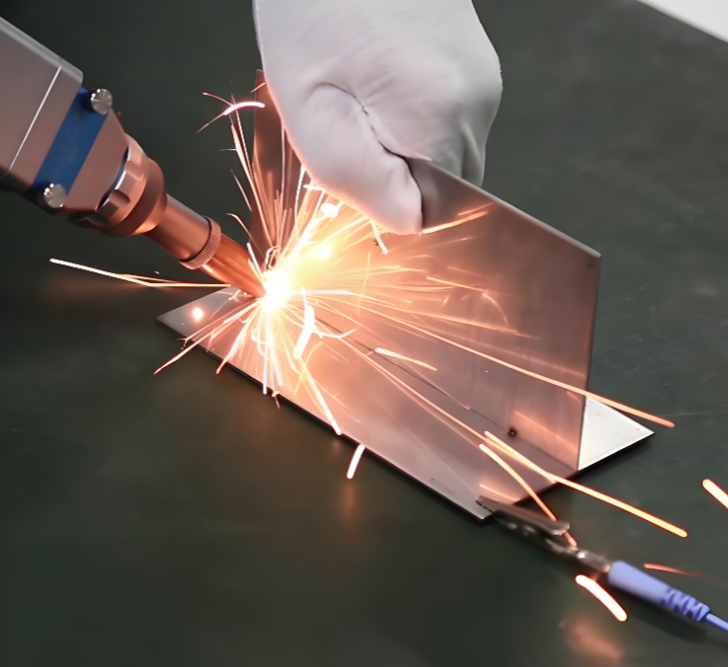
In today’s advanced manufacturing landscape, the choice of joining technology can significantly impact product quality, production efficiency, and overall cost structure. Two of the most prominent laser-based joining methods—laser welding and laser brazing—offer distinct advantages for different applications. Understanding their fundamental differences is essential for manufacturers seeking to optimize their production processes.
The fundamental distinction between laser welding and laser brazing lies in what actually melts during the process.
- Laser welding uses a highly concentrated laser beam to heat the base metals to their melting point, causing them to melt and fuse together directly. The result is a narrow, deep weld with a small heat-affected zone. The base materials themselves become part of the joint, creating a unified structure.
- Laser brazing, by contrast, uses the laser as a heat source to melt only a filler metal—such as silicon bronze, copper alloys, or nickel-based materials—which is then drawn into the joint by capillary action. The base metals themselves do not melt. This fundamental difference drives nearly every other distinction between the two processes.
Laser welding has become the go-to solution for applications demanding superior joint strength and high throughput. The concentrated energy creates an extremely narrow heat-affected zone, minimizing material distortion and preserving the mechanical properties of the surrounding material.
Key Advantages:
- Exceptional joint strength — Studies have shown laser welding can achieve fracture loads exceeding 800 N, significantly outperforming brazed joints in structural applications
- High-speed processing — Welding speeds can reach 100–400 mm/s, dramatically improving production efficiency
- Minimal heat-affected zone — Reduces material deformation and preserves surrounding properties
- Seamless automation integration — Well-suited for robotic systems and automated production lines
- Versatile material compatibility — Works with nearly all metals, including stainless steel, aluminum, titanium, and dissimilar metals
Laser brazing excels where joint appearance, minimal thermal distortion, and the joining of dissimilar materials are paramount. Because the base metals never reach their melting point, their metallurgical properties remain intact.
Key Advantages:
- Exceptional surface finish — Produces smooth, clean joints that often require no post-processing or grinding
- Minimal heat distortion — Extremely low heat input prevents warping, burning, or blow-through on thin materials
- Superior dissimilar metal joining — Excels at joining different metals, such as copper to steel, which can be difficult or impossible to weld
- Lower initial investment — Equipment costs are generally moderate compared to full laser welding systems
- Complex geometry capability — Can bond multiple interfaces simultaneously, unlike laser welding which is primarily limited to continuous perimeter seams
- Flux-free operation — Many laser brazing applications can be performed without chemical flux, eliminating contamination and residue concerns
The decision between laser welding and laser brazing ultimately depends on your specific application requirements:
Choose laser welding when structural integrity, joint strength, and production speed are your primary concerns—and when your budget can accommodate the higher initial investment.
Choose laser brazing when joint appearance, minimal thermal distortion, and the ability to join dissimilar materials are critical—and when moderate joint strength is sufficient for the application.
Both technologies represent the forefront of precision joining, and many manufacturers are now incorporating both methods into their production lines to leverage the unique advantages of each.