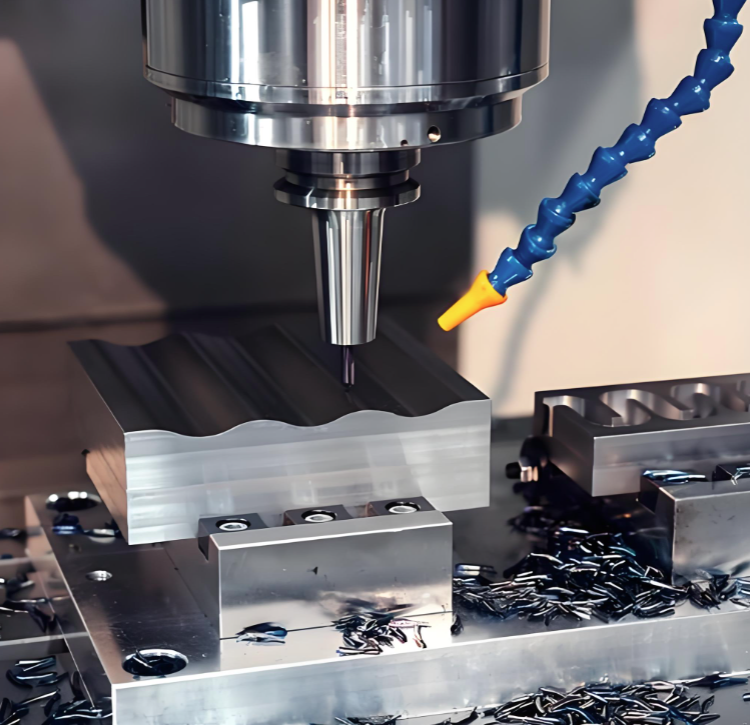
Key Considerations for Machining 6082 Aluminum Alloy Automotive Components
- Material
6082 aluminum alloy (EN AW-6082, also designated as AA6082, HE30, or DIN 3.2315) is a heat-treatable Al-Mg-Si-Mn alloy widely used in the automotive industry for highly stressed structural components. It offers an excellent combination of high strength-to-weight ratio, good corrosion resistance, and favorable machinability. Common automotive applications include suspension arms, chassis components, control arms, safety-critical structural parts, and anti-vibration bushings.
The T6 temper (solution heat-treated and artificially aged) is the most common condition for automotive components, providing tensile strength up to 310 MPa and yield strength around 260 MPa.
- Tool Selection and Cutting Parameters
2.1 Tool Materials and Coatings
Carbide tools are recommended for machining 6082 aluminum due to their durability. Sharp cutting tools are essential to reduce work hardening and improve surface finish.
TiN (Titanium Nitride) coatings help reduce built-up edge and improve tool lifespan. ZrN (Zirconium Nitride) offers a good balance between performance and cost.
Diamond-coated tools provide the lowest friction but are more expensive, best suited for high-volume production.
Avoid AlCrN coatings as they may increase adhesion with aluminum.
Uncoated carbide tools can be used with proper coolant application.
2.2 Spindle Speeds and Feeds
Recommended spindle speeds range between 8,000–15,000 RPM, depending on tool diameter.
Feed rates typically fall between 1,500–3,000 mm/min to balance efficiency and surface finish.
For turning operations, cutting speeds of 500–800 m/min with feed rates of 0.1–0.15 mm/rev have been studied for 6082 T4 alloy.
For milling, cutting speeds between 36–40 m/min with feed rates of 0.14–0.18 mm/rev are recommended.
Depth of cut should not exceed 50% of the tool diameter to avoid deflection.
2.3 Tool Geometry
Carbide end mills with 3+ flutes are ideal for clean cuts due to the alloy’s somewhat “gummy” nature.
Chip breakers are recommended as 6082 in T6 temper tends to produce long, stringy chips; chip breakers help produce tight coils of swarf.
Peck drilling techniques are recommended for improving chip formation during drilling operations.
- Cooling and Lubrication
3.1 Coolant Application
Flood coolant or air blast is essential to prevent chip welding (built-up edge) and extend tool life.
Coolant helps reduce heat generation during machining, which is critical as excessive heat may affect material properties.
Minimum Quantity Lubrication (MQL) has shown promising results for sustainable machining of Al6082.
3.2 Heat Management
Excessive heat during machining can lead to:
Faster tool wear
Potential alteration of material properties
Chip welding and poor surface finish
Using appropriate coolants or lubricants is essential to manage heat generation.
- Workholding and Fixturing
Proper fixturing is essential to minimize vibration and deflection during machining.
Adequate workholding prevents vibrations and ensures precise cuts.
For thin sections or complex geometries, vibration control is particularly critical to maintain dimensional accuracy.
- Residual Stress and Distortion Control
6082-T6 aluminum bars can suffer from internal stress, which may lead to slight distortion or dimensional changes after machining.
Residual stresses induced by machining operations can cause part distortion, especially in thin-walled sections.
Pre-machining stress relief may be needed for high-precision parts.
Post-processing stress relieving can improve final part quality and dimensional stability.
The T651 temper (stress-relieved version of T6) is often preferred for plate and precision machining work.
- Chip Control
6082 in T6 temper tends to produce long, stringy chips that can interfere with machining operations.
Chip evacuation becomes critical; using chip breakers and appropriate feed rates helps manage chip formation.
Proper coolant application prevents chip welding to the cutting tool.
Compared to 6061, 6082 has higher silicon content, making it slightly harder but more abrasive to tools; chip control is somewhat easier with 6061 due to its lower gumminess.
- Post-Machining Considerations
7.1 Surface Finish and Deburring
Burr formation is frequent due to the alloy’s ductility, requiring deburring passes or manual finishing.
Surface galling may occur if cutting speeds are too low or coolant is inadequate.
Tool marks may be visible if stepover distances exceed 10% of tool diameter.
Compared to some other 6000 series alloys, 6082 is better suited for highly stressed parts but may be less ideal when a smoother cosmetic finish is the main priority.
7.2 Heat Treatment
Ensure that the heat treatment process is correct to achieve the required mechanical properties.
The T6 tempering process involves solution heat treatment, quenching, and artificial aging.
Post-weld heat treatment can significantly increase tensile strength and hardness of welded joints.
7.3 Surface Treatment
6082 can be anodized to enhance corrosion resistance and provide an aesthetically appealing surface finish.
6082 is one of the top choices for hardcoat anodizing.
The alloy has good anodic reactivity, making it suitable for various anodizing processes.
By following these guidelines, we can effectively machine 6082 aluminum alloy automotive components while minimizing tool wear, preventing distortion, and achieving the required dimensional accuracy and surface quality.