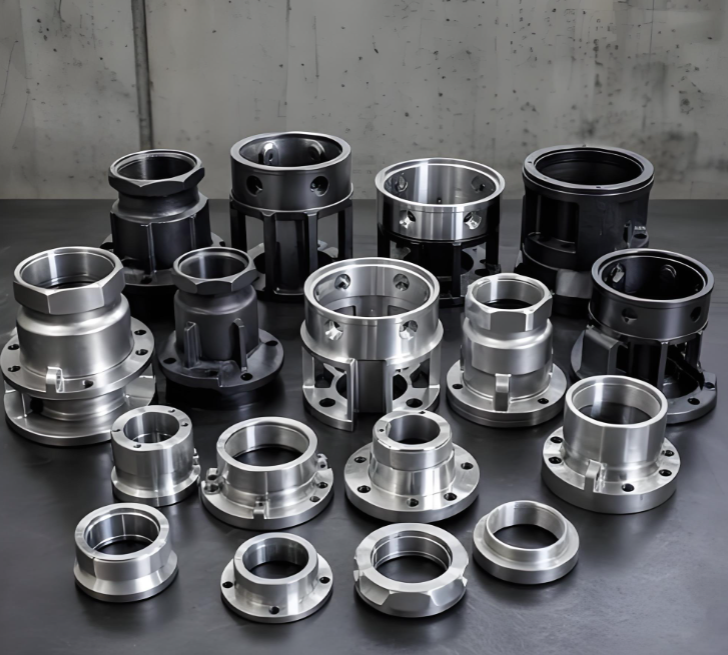
Stainless steel castings are widely used across industrial equipment, food processing, medical devices, and chemical handling due to their excellent corrosion resistance, high strength, and durability. However, machining these castings presents unique challenges. Stainless steel is difficult to machine—it has poor thermal conductivity, high viscosity, and a tendency to work-harden. Here are the key considerations every shop must address when machining stainless steel castings.
- Pre-Machining Preparation
Before any cutting begins, castings should undergo annealing to eliminate residual casting stress, preventing deformation or cracking during subsequent machining. Thorough pre-machining checks—including dimensional verification and surface inspection—are essential to ensure accuracy and quality before parts enter the CNC phase.
- Tool Selection and Geometry
Choosing the right tooling is critical. Sharp carbide tools—such as YG8 grades—are recommended, with a rake angle greater than 15 degrees to reduce cutting resistance. Coated tools with TiAlN coatings extend tool life and ensure processing stability. Tool wear must be monitored closely; check every 50 pieces to avoid dull tools that can cause cracking.
- Cutting Parameter Optimization
Stainless steel’s high viscosity promotes built-up edge formation, affecting surface finish. Recommended parameters include a linear speed of 80–120 m/min and a feed rate of 0.05–0.1 mm/r, adjusted according to casting hardness. Using a low-speed, heavy-feed strategy helps reduce cutting heat accumulation. One case study showed that reducing feed rate from 0.15 mm/r to 0.08 mm/r cut crack rates by 70%.
- Staged Machining to Reduce Stress
Roughing and finishing should be performed separately. Reserve a 0.5–1 mm margin during roughing, and use a multi-pass strategy with small depths of cut (0.1–0.3 mm) for finishing. This approach controls deformation—in one valve casting example, distortion was held within 0.05 mm over three passes.
- Cooling and Lubrication
Effective cooling is non-negotiable. Use water-soluble coolant with extreme pressure additives to cool the cutting zone and reduce tool-workpiece friction. For deep holes or complex structures, high-pressure internal cooling ensures coolant reaches the cutting area directly. Large castings may benefit from pre-cooling to 20–25°C before machining.
- Clamping and Fixturing
Use flexible or hydraulic clamps to disperse pressure and avoid localized deformation. For thin-walled parts, add auxiliary support—such as vacuum suction cups—to maintain stability during cutting.
- Post-Machining Stress Relief
Stress relief annealing immediately after machining (heating to 300–400°C and holding for 2 hours) helps prevent delayed distortion. Vibration aging treatment offers a lower-cost alternative.
- Inspection and Quality Control
Post-machining inspection using CMM or optical profilers ensures tolerances are controlled within allowable ranges. For high-demand applications like medical or aerospace components, non-destructive testing such as X-ray inspection is also required to eliminate internal defects.
Machining stainless steel castings demands careful attention to tooling, cutting parameters, cooling, and stress management. By implementing staged machining, selecting appropriate tools, and maintaining rigorous process controls, shops can significantly reduce scrap rates, improve dimensional accuracy, and deliver high-quality components that meet the most demanding specifications.